Prepared by: Paul Ransfield, Kapai Group and manus.AI
Purpose: High-level rationale for presenting #iuwe as a scalable model for affordable community-owned healthy social change, enabled by media and technology, governed by communitarian benefit, and accelerated through AI++.
Executive Overview
#iuwe has moved from an educational idea into a working production architecture. The first completed one-minute video proves the template: 12 five-second nano-learning events can be sequenced, produced, tested, and played as a coherent nano-learning unit. Each one-minute unit can also be opened horizontally into deeper resource categories, such as kōhiko conversation sparkles, whakaū affirmations, ako horipū direct instructions, phonetic demonstrations, kupu drills, kiwaha, names, and contextual media.
The immediate production goal is the first hour: 60 one-minute videos, each built from twelve five-second events. The wider system goal is much larger: 2,160 one-minute videos across 36 hours of learning, scheduled and streamed through iho.whanau.tv, then adapted across a wider COOP ecosystem: Community-Owned Online Platforms. Inside that umbrella, COOL remains the learning vertical: Community-Owned Online Learning.
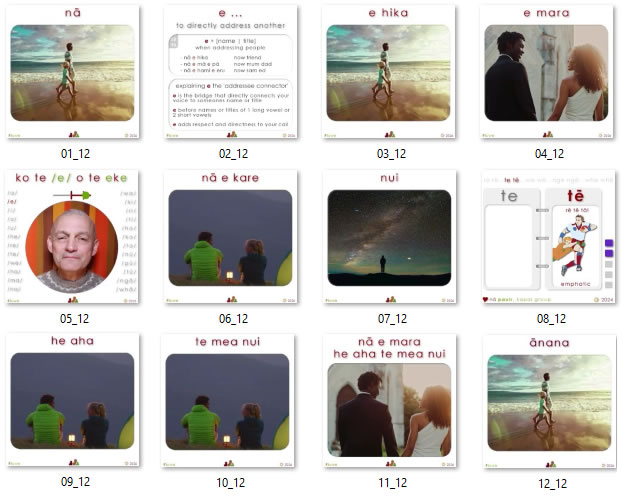
One minute proves the method. Sixty minutes proves the hour. Thirty-six hours proves the platform.
The high-level rationale is not simply that #iuwe can produce language-learning media. The rationale is that #iuwe demonstrates how community domain expertise, AI-assisted production, disciplined sequencing, and local ownership can combine to make healthy social change affordable. The project uses media and technology as enabling infrastructure, but its adoption logic is social: people will adopt what feels useful, warm, repeatable, culturally grounded, and owned close enough to the communities it serves.
The Strategic Claim
For the last two centuries, many technology advances required concentrated capital before they could scale. Factories, railways, broadcast networks, large publishing systems, universities, computing infrastructure, and platform economies all tilted the playing field toward those able to localise capital. Once capital was localised, the benefits were often localised as well. Communities supplied labour, culture, language, care, land, memory, teaching, and trust, but the surplus commonly flowed upward to those who owned the machinery of production.
AI changes the probability space. It does not automatically create justice, but it changes what can now be organised. The scarce input is no longer only capital. Increasingly, the scarce input is domain expertise: knowledge accumulated across human years of practice, teaching, caring, speaking, making, listening, and belonging. That expertise is expensive to acquire individually, but abundant across communities.
For two centuries, technology rewarded those who could concentrate capital. AI can reward those who can organise knowledge.
#iuwe is a practical example of that shift. It begins with te reo Māori, oral practice, phonetic judgement, visual memory, direct instruction, warm affirmation, and a community-owned learning pathway. AI assists the production system, but the human design intelligence remains central. The result is not AI replacing teachers, workers, or communities. The result is AI helping communities convert knowledge they already hold into reusable, scheduled, teachable, and ownable media assets.
| Old Capital-Intensive Technology Pattern | #iuwe AI++ Communitarian Pattern |
|---|---|
| Capital owns the machinery of scale. | Communities hold the domain expertise that gives scale meaning. |
| Infrastructure must be centralised before production can begin. | Production can begin locally through small repeatable media units. |
| Workers and learners are treated as users, consumers, or costs. | People are treated as holders of pattern, memory, care, language, and judgement. |
| Benefits flow toward whoever owns the platform. | Benefits are designed to return to the physical communities that generate and sustain the value. |
| Success is measured by extraction, reach, or headcount reduction. | Success is measured by participation, learning, wellbeing, adoption, and community revenue return. |
AI++: Artificial Intelligence Plus Animal Instinct
The project champions AI++, a deliberate reference to the productive power of C++ and a deliberate extension beyond narrow artificial intelligence. In #iuwe, AI++ means Artificial Intelligence plus Animal Instinct. Artificial Intelligence brings computational pattern recognition, variation, speed, formatting, asset generation, and production assistance. Animal Instinct brings embodied pattern recognition: intuition, timing, trust, fear, play, rhythm, memory, cultural sense, and the felt judgement of what a community will actually adopt.
This matters because healthy social change is not adopted only because an algorithm optimises content. It is adopted because people recognise something as useful, safe, beautiful, familiar, surprising, or worth repeating. #iuwe therefore treats Artificial Intelligence as a co-design actor, not as the author of the system. The other co-design actor is humankind’s deep animal intelligence: the pattern-recognition capacity that predicts adoption before institutions have metrics to describe it.
AI is computational pattern recognition. Animal Instinct is embodied pattern recognition. AI++ is the co-design layer where both learn to work together.
AI++ is also how #iuwe differentiates itself from the austerity version of AI. The austerity frame asks how many people can be removed. The AI++ communitarian frame asks how much human knowledge can finally be activated affordably. Paired with austerity, AI cuts. Paired with extraction, AI concentrates. Paired with community ownership and domain expertise, AI can multiply local capability.
| AI Used for Austerity | AI++ Used for Communitarian Capability |
|---|---|
| “How many workers can we remove?” | “How much human knowledge can we activate?” |
| Treats AI as replacement. | Treats AI as a co-design actor. |
| Optimises institutional cost reduction. | Optimises community capability, participation, and wellbeing. |
| Centralises benefit around owners, executives, and platforms. | Returns value to whānau, hapori, kaitiaki, creators, learners, and local systems. |
| Removes the human from the process. | Keeps the human voice, mouth shape, judgement, memory, and relational invitation at the centre. |
The social meaning of #with_AI_unavoidable_without_unaffordable sits inside this AI++ frame. The phrase is not a slogan for replacing workers. It is an access principle. If AI is becoming unavoidable in work, learning, media, and public life, then being without AI must not become unaffordable. Communities need affordable access to the tools that can help them preserve language, multiply teaching capacity, build local media, organise knowledge, and create new pathways for healthy social change.
The ī-ahikā Principle: Digital Revenue Returning to the Physical World
#iuwe is enabled by media and technology, but it is not designed as a platform-extraction model. Its adoption logic is ī-ahikā: a digital extension of the ahi kā principle, where the fire that keeps the community warm must continue to feed the place, the people, and the relationships from which the value arises.
The key proposition is simple. If social learning generates major digital revenue, the value should not be captured primarily by distant technology owners, global platforms, or capital-concentrating intermediaries. A substantial majority should return to the physical world: the local whānau, hapori, kaitiaki, learning spaces, creators, language holders, cultural workers, and community-owned platforms that generate and sustain the learning value.
ī-ahikā means the digital fire must warm the physical community.
For presentation purposes, the principle can be stated as an 80% community-return design rule. If a learning pathway is created from local knowledge, community language, cultural context, and human teaching expertise, then the platform architecture should be designed so that 80% of digital revenue returns to the physical communities and local ecosystems that make the value possible. The remaining share can sustain shared infrastructure, technology, coordination, hosting, support, and platform development, but the default moral direction of revenue should be local, not extractive.
| Revenue Logic | Platform-Extraction Model | ī-ahikā Community-Return Model |
|---|---|---|
| Primary beneficiary | Platform owner or capital holder. | Physical communities that generate and sustain learning value. |
| Direction of surplus | Upward and outward. | Backward into place, whānau, hapori, and kaitiaki. |
| Role of technology | Capture attention and monetise behaviour. | Schedule learning, distribute capability, and return value. |
| Role of community | Content source, user base, or market. | Co-owner, knowledge holder, producer, adopter, and beneficiary. |
| Healthy social change | Secondary or branded outcome. | Primary design purpose. |
This is why #iuwe is not only a curriculum project. It is a revenue-governance argument. Social learning may be globally valuable, but global value should not automatically mean distant capture. The #iuwe proposition is that digital media can scale globally while value returns locally. That is the difference between a platform economy and a community-owned learning economy.
COOP and COOL: Naming the Communitarian Platform Economy
The stronger philosophical frame is communitarianism: a practical, future-facing language for community benefit, community consent, community publishing, community revenue return, and community kaitiakitanga. #iuwe does not need legacy ideological shorthand to explain itself. It needs a language ordinary communities can recognise, adopt, and defend: ownership, care, trust, publishing, learning, and revenue returning to the people and places that generate the value.
The naming architecture can therefore be sharpened. COOP becomes the master category: Community-Owned Online Platforms. It is broad enough to include learning, media, publishing, marketplaces, governance, identity, cultural archives, local enterprise, and revenue return. COOL remains the first attractive proof point: Community-Owned Online Learning. COOL is friendly, memorable, and useful, but COOP is the architecture that can move from hipster appeal into mass consciousness.
COOL teaches. COOP governs. COOL attracts. COOP anchors. COOL is the doorway. COOP is the architecture.
| Term | Strategic Role | Best Public Use |
|---|---|---|
| COOP | Umbrella architecture. | Community-Owned Online Platforms: the full communitarian platform economy. |
| COOL | Learning vertical. | Community-Owned Online Learning: the education, language, and social-learning layer inside COOP. |
| Communitarianism | Philosophical language. | The positive social frame that distinguishes #iuwe from platform extraction, state ownership, and old ideological baggage. |
A simple investor-facing line follows from this hierarchy:
The world does not need another extractive platform economy. It needs COOP: Community-Owned Online Platforms, with COOL as the learning layer.
This also clarifies the role of #iuwe. #iuwe proves COOL because language learning is the first visible pathway. COOL then proves COOP because the same ownership, consent, publishing, scheduling, and revenue-return architecture can support wider community-owned media and platform systems. In that sequence, #iuwe proves COOL; COOL proves COOP; COOP makes communitarianism visible at platform scale.
Platform Throttling, Censorship, and the COOP Trust Layer
The recent collapse of unpaid short-video reach is not only a marketing inconvenience. It is a community-governance signal. When a creator can publish consistently, adjust hashtags, maintain public visibility settings, and still see distribution fall toward zero, the practical lesson is that the platform is not a neutral public square. It is an attention gate that can throttle visibility, whether through moderation, ranking systems, automated classification, commercial incentives, or opaque policy enforcement.
For #iuwe, this should not be framed as panic or grievance. It should be framed as evidence. A large extractive platform may still be useful as rented distribution, especially when a small paid boost can place a message before thousands of eyes. But the platform cannot be the trust foundation for a community-owned language and social-change system. If access to the audience can be switched off and sold back, the community needs its own endpoint, its own publishing record, its own consent logic, and its own revenue-return architecture.
When extractive platforms can switch off organic reach and sell back visibility, COOP becomes the trust layer: community-owned endpoints, community-owned publishing, and community-return economics.
This is why throttling or censorship is a community issue, not merely a creator issue. If a community’s language, learning pathway, health message, local enterprise, or cultural archive depends entirely on an external attention platform, then the community does not fully control how its own voice reaches people. The COOP response is not to abandon external platforms. The response is to demote them. TikTok, Instagram, YouTube, Facebook, and similar systems can remain useful as roadside signage, paid tests, audience discovery surfaces, and temporary amplification channels. The primary home should remain a community-owned endpoint such as whanau.tv/iuwe/{id} and the learning stream at iho.whanau.tv.
| Platform Dependency Problem | COOP Trust-Layer Response |
|---|---|
| Organic reach can be throttled without a clear appeal pathway. | Maintain a community-owned canonical endpoint for each asset, learning unit, and public message. |
| Visibility can be sold back through paid promotion. | Treat paid reach as market testing, not as ownership of the audience relationship. |
| Algorithmic distribution can misread cultural, political, or language content. | Preserve community-controlled publishing, metadata, consent, and context. |
| Platform metrics can define success too narrowly. | Measure trust, learning, participation, revenue return, and community adoption. |
| A creator can be isolated by opaque moderation or ranking systems. | Build COOP infrastructure so the community retains continuity beyond any one platform. |
The operational discipline is simple. Keep producing the two-minute spoken reflections. Keep closing with Purea Nei. Use paid platform reach selectively when a message deserves testing in front of thousands of people. But do not confuse rented reach with community infrastructure. External platforms can help people discover the kaupapa; COOP must hold the kaupapa.
The Curator Care Key
The COOP trust layer also needs a clear reward pathway for the people who make community knowledge safe, useful, and publishable. Alongside the community care key, which recognises relational continuity, local trust, and wellbeing work, #iuwe should name the curator care key: the trust-and-publication mechanism that rewards makers, validators, editors, cultural kaitiaki, and curators of publishable content.
This distinction matters because community-owned publishing is not just upload infrastructure. It is care work. A video, lesson, transcript, phrase, waiata, health message, or cultural explanation becomes public value only when it has been shaped with consent, context, accuracy, cultural sense, and educational usefulness. The curator care key therefore recognises the labour that extractive platforms usually hide: the work of making knowledge fit to enter the community record.
The curator care key rewards trustworthy publication. COOP does not only reward attention; it rewards the care, curation, validation, and kaitiakitanga that make community knowledge safe to share.
| Key | Role in the COOP System | What It Rewards |
|---|---|---|
| Community care key | Relational and wellbeing layer. | Care, connection, whānau-facing continuity, local trust, and the human work that keeps participation healthy. |
| Curator care key | Publishing and trust layer. | Makers, validators, editors, cultural kaitiaki, and curators who prepare trustworthy content for public use. |
This is another point of separation from extractive platforms. A commercial attention platform primarily rewards engagement. A COOP system should reward trustworthy publication: consented content, contextual metadata, cultural safety, educational usefulness, and the disciplined labour of turning lived knowledge into shared community infrastructure.
From Page-Constrained Learning to Time-Based Learning
A physical book is constrained by pages, margins, print cost, and the fixed sequence of reading. A time-based learning system is constrained differently. Its design question is not only “what can fit on the page?” but “what should be encountered next?”
#iuwe organises language by time. The learning surface is the minute, the five-second event, the hour, and the scheduled pathway. This changes the production logic. A concept does not need to be fully explained in one place. It can be pre-taught, heard, seen, repeated, affirmed, drilled, varied, and retrieved across many small encounters.
Books organise language by page. #iuwe organises language by time.
The first one-minute video has validated this model. It is not merely a vertical sequence of twelve frames. It can also be explored horizontally through any of its twelve categories. A learner, teacher, producer, investor, or community partner can look at one minute as a single scheduled video, or dive sideways into a list of all ako horipū, all kōhiko, all whakaū, all phonetic drills, all names, all kiwaha, or all contextual uses of a target item such as nā.
| Learning Object | Vertical Function | Horizontal Function |
|---|---|---|
| One five-second event | Carries one precise learning action inside the minute. | Belongs to a reusable category bank. |
| One one-minute video | Sequences 12 learning events into a complete unit. | Opens into 12 resource categories. |
| First 12 minutes | Establishes the first strict set of production patterns. | Allows pre-teaching of kōhiko, whakaū, ako horipū, phonetics, kupu, and visual contexts. |
| First 60 minutes | Proves the first hour of the #iuwe Triple Helix pathway. | Demonstrates width and breadth across an investor-facing production map. |
| 36 hours | Scales into 2,160 one-minute videos. | Becomes a community-owned, scheduled, reusable learning-media system. |
This is the significance of the recent production breakthrough. The first completed minute proves that the strict template can hold both sequence and depth. It can teach forward and organise sideways. That is a production advantage, a pedagogical advantage, and a platform advantage.
The First-Hour Production Architecture
The first hour is built from 60 one-minute videos. Each one-minute video contains 12 five-second learning events. This gives 720 learning events in the hour. The production task is therefore not to make one large lesson, but to design the optimal sequence of 720 small encounters.
The first hour is not a general language course. It is concentrated oral and phonetic practice for te reo Māori, supported by direct instruction, affirmation, conversational sparkles, names, kiwaha, and contextual frames. It is designed to make learners safer, warmer, and more capable inside speech before the system asks them to carry heavier language performance.
| Scale | Quantity | Design Role |
|---|---|---|
| Frame | 5 seconds | One precise media-supported learning event. |
| Video | 12 frames / 1 minute | One complete micro-sequence. |
| First hour | 60 videos / 720 frames | One scheduled learning architecture. |
| Full pathway | 36 hours / 2,160 videos | A scalable community-owned media curriculum. |
| Platform layer | iho.whanau.tv plus the wider COOP ecosystem, with COOL as the learning vertical |
Distribution, scheduling, access, local adaptation, publishing, and revenue return. |
The first-hour promise remains practical and grounded. After one hour, the learner has been guided toward singing the first verse of Purea Nei word by word, speaking a whakataki, completing a mihi, opening with a karakia, and joining the call to action: Me tāpiri e iuwe ō tātou reo!
The deeper promise is that each hour also trains the learner into the Teaching to Learn — Learning to Teach Triple Helix. The learner is not only receiving content. They are absorbing the micro-moves that make the content teachable: how to open softly, how to affirm, how to instruct, how to repeat, how to hear, how to slow down, how to restore confidence, and how to pass the learning on.
The immediate presentation pathway can now mirror the learning pathway itself. Over the next few weeks, Paul can speak to this document in a sequence of short two-minute videos, practising the rationale out loud while continuing to practise singing Purea Nei as the closing waiata. This creates a living bridge between investor narrative and learner embodiment: the strategic document becomes spoken practice; the spoken practice becomes media; the waiata closes each reflection by returning the architecture to voice, rhythm, breath, and kaupapa.
| Two-Minute Video Practice Arc | Purpose | Closing Anchor |
|---|---|---|
| Speak one strategic section at a time. | Builds confidence, clarity, and repeatable investor language. | Close with Purea Nei practice. |
| Record short reflections rather than perfect lectures. | Keeps the process achievable around full-time work and ongoing production. | Let the waiata mark progress rather than performance pressure. |
| Use the document as the spoken spine. | Turns the overview into a rehearsed public narrative. | Return each clip to breath, sound, and te reo. |
| Publish or hold clips as appropriate. | Creates a phased content trail for partners, whānau, and future investors. | Make the closing song the emotional landing point. |
The 12-Event Minute as the Core Production Unit
The 12-event minute is the atomic production unit of #iuwe. It is short enough to make disciplined production possible, yet rich enough to carry visual context, oral practice, phonetic precision, relational warmth, and retrieval. The design also works for someone producing around a demanding day job, because the unit is bounded, repeatable, and measurable.
| Event Layer | Function Inside the Minute | Why It Matters |
|---|---|---|
| Kōhiko | Opens the exchange with a small conversational sparkle. | Speech begins gently rather than through blunt questioning. |
| Whakaū | Affirms effort, quality, delight, and continuation. | The learner feels seen, warmed, and safe to try again. |
| Ako horipū | Gives clear direct instruction. | The next action is obvious and repeatable. |
| Phonetic drill | Demonstrates mouth shape, sound, and rhythm. | Learners hear and see how te reo is physically formed. |
| Kupu / kiwaha | Carries target words and phrases. | Meaning is built through repeated oral contact. |
| Visual context | Grounds the utterance in a scene, image, or social cue. | Repetition is strengthened without visual fatigue. |
| Anchor phrase | Places the target item inside a larger frame. | The learner experiences the kupu as part of living speech. |
The production template has now been tested with visually engaging, free-to-use media assets, including curated stock video, refreshed digital assets, phonetic demonstration videos, and rendered text layers. This proves that #iuwe can combine human judgement, AI-assisted asset production, and structured sequencing into a repeatable media workflow.
Kōhiko, Whakaū, and Ako Horipū: The First-Hour Social Learning Stack
The co-design process has clarified that the first hour needs more than word lists. It needs a social learning stack that shapes how the learner enters speech, remains emotionally safe, and knows what to do next. The first 12 minutes therefore celebrate three companion layers: kōhiko, whakaū, and ako horipū.
Kōhiko are the small sparkles of conversation. They are not blunt demands such as “who are you?” They are gentle sounds that make kōrero possible: nā, a, tēnā, āna, āe nā, and ia nā. The poetic founding line is:
ko te kōhiko i te timatanga
the sparkle, in the beginning
Whakaū are affirmations in the heart. They warm the learner’s pathway and keep practice repeatable. The first-hour bank includes expressions such as ānana, i mahi pai, tau kē nei, ka mau te wehi, mīharo kē, and whū. The design line is:
ko te whakaū i te ngākau
the affirmation, in the heart
Ako horipū are direct instructions used in the learning moment. They help learners know what action comes next: Whakarongo mai, Kī mai, Kia pōturi, Kī anō, E āta kī / Āta kī mai, and Whakahokia mai. In #iuwe, direct instruction is not a harsh command system. It is a clarity layer: a way to keep the shared pathway steady.
| Layer | Māori Frame | Learner Experience | System Function |
|---|---|---|---|
| Kōhiko | Sparkles of conversation. | “I can begin safely.” | Opens speech gently. |
| Whakaū | Affirmations in the heart. | “My effort has landed somewhere warm.” | Sustains confidence and repetition. |
| Ako horipū | Direct instruction in the learning moment. | “I know what to do next.” | Guides the next action clearly. |
Together, these layers show why the first hour is not merely content delivery. It is the architecture of a safe speaking environment.
Rich Media Without Visual Fatigue
The co-design process has also solved a practical production problem: how to repeat a target item often enough for learning without making the learner feel they are seeing the same slide again and again. The answer is to separate utterance repetition from visual repetition.
For example, the word nā can appear across many contexts. The sound repeats, but the visual situation changes. The learner experiences nā as a living conversational move rather than as a static flashcard. The same asset logic can then be used for other kōhiko, affirmations, and direct-instruction prompts where the context remains compatible with the utterance.
Across the strict sets of 12, repetition belongs to the sound, not to the slide.
This creates a reusable media engine. A base visual context can be paired with one text layer for nā, then adapted for tēnā, āe nā, whakaū, or ako horipū where appropriate. Python scripts, AI-assisted image or text generation, and disciplined naming conventions allow the system to produce outliers quickly without breaking the core design.
| Asset Layer | What Stays Stable | What Varies | Learning Value |
|---|---|---|---|
| Target sound or phrase | The oral item being practised. | Context, tone, and placement. | Builds retrieval through repetition. |
| Visual context | The scene, relationship, or social cue. | Text overlay and target phrase. | Prevents fatigue and adds social evidence. |
| Text layer | Layout, font hierarchy, and category logic. | Māori item and English support text. | Enables rapid aligned production. |
| Scheduled placement | The minute and five-second event. | Which asset is selected for that moment. | Makes the sequence feel designed, not duplicated. |
This is where #iuwe turns media production into a learning system. A book repeats text because it cannot afford infinite context. A time-based media system can repeat the kupu while varying the world around it.
From First Minute to 2,160 Minutes
The first completed one-minute video is a proof of production quality. The remaining 59 videos in the first hour are no longer an unresolved design problem. They are a disciplined production schedule. The key template has landed, the asset libraries have been refreshed, and the workflow for text and visual outliers has become fast enough to support ongoing production.
The pathway from here is cumulative. The first hour demonstrates the width and breadth of the model. The full 36-hour pathway demonstrates scale. Once the architecture is proven through te reo Māori, it can be adapted across other languages and communities by replacing the phonetic groups, cultural anchor frames, names, images, and local social-learning assets.
| Milestone | What It Proves | Strategic Meaning |
|---|---|---|
| 1 minute completed | The template works in real media. | The method is no longer theoretical. |
| 12 minutes completed | The first strict set is teachable and extensible. | Category depth and sequence can operate together. |
| 60 minutes completed | The first hour can be presented as a complete architecture. | Investors and partners can see the breadth of the model. |
| 36 hours completed | The system scales to 2,160 one-minute videos. | #iuwe becomes a platform-ready social learning pathway. |
| COOP ecosystem adoption | Other community-owned online platforms can adapt the model, with COOL as one learning vertical. | The value of the architecture is not locked to one institution, course, or market. |
The replication note remains important. The 12-event minute, phonetic grouping, generative cultural frame, name/place layer, affirmation layer, direct-instruction layer, and rich-media asset logic can transfer to Mandarin, Arabic, Russian, or other languages. The transfer should not copy Māori content into other contexts. It should copy the architecture of community-owned adaptation.